Scusa or Mi dispiace? Why Italian Has Two Ways to Say "Sorry"
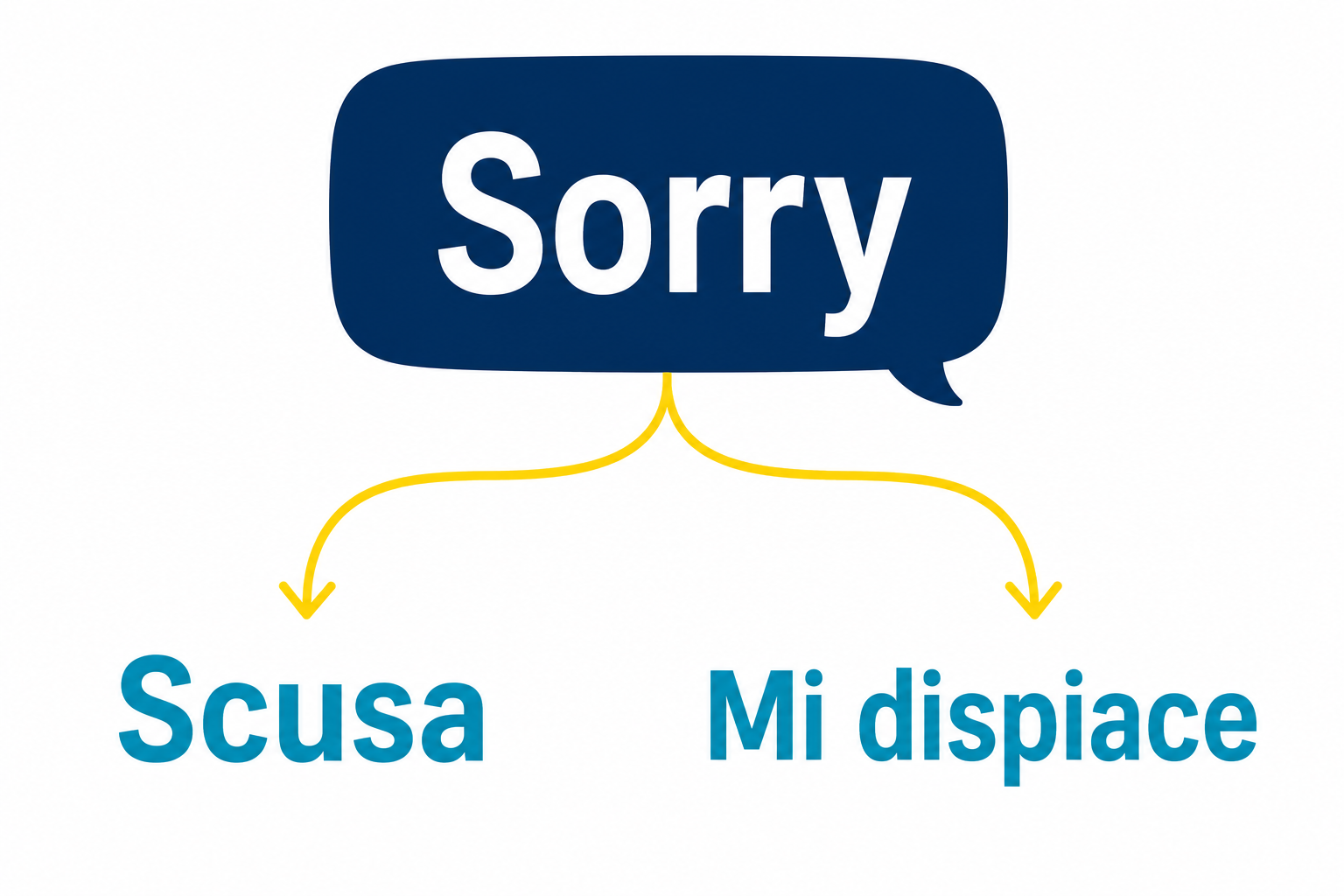
Scusa or Mi dispiace?
Why Italian Has Two Ways
to Say "Sorry"
One of the easiest mistakes to make in Italian is assuming that scusa and mi dispiace mean the same thing.
After all, they're both translated as sorry in dictionaries.
So how do you know which one to choose?
At first, it looks like a simple vocabulary question.
But it isn't.
It's really about what you want your sorry to do.
One word, two different jobs
Imagine you're walking through a busy street. You accidentally step on someone's foot.
What do you say?
Scusa!
Now imagine a friend tells you they've just lost their job.
This time, you'd say:
Mi dispiace.
In English, both situations usually call for exactly the same word, Sorry.
Italian makes a distinction.
Not because one situation is more serious than the other, but because you're trying to achieve two different things.
In the first case, the focus is on your action.
In the second, it's on your regret.
That's the real difference.
Scusa repairs the relationship
When you say scusa, you're acknowledging that your action has affected someone else, and you're trying to make things right again.
That's why Italians use scusa when they:
- bump into someone;
- interrupt a conversation;
- arrive late;
- ask someone to make room;
- make a mistake that inconveniences another person.
For example:
Scusa, posso farti una domanda?
Sorry, can I ask you a question?
Scusa per il ritardo.
Sorry I'm late.
Scusa, ti ho pestato un piede!
Sorry, I stepped on your foot!
In every case, you're asking the other person to excuse your action.
Mi dispiace expresses your feelings
Mi dispiace has a different job.
You're not asking someone to forgive you.
You're expressing how you feel.
Sometimes that means regret.
Sometimes it means sympathy.
For example:
Mi dispiace, non posso venire.
I'm sorry, I can't come.
Mi dispiace averti deluso.
I'm sorry I let you down.
Mi dispiace che tu stia passando un momento difficile.
I'm sorry you're going through a difficult time.
Sometimes you haven't done anything wrong at all.
You're simply letting the other person know that you understand their disappointment or sadness.
Sometimes you can use both
Some situations allow both expressions, but with a slightly different meaning.
Imagine you've forgotten a friend's birthday.
You could say:
Scusa, mi sono completamente dimenticato del tuo compleanno.
Here, you're apologising for your mistake.
Or:
Mi dispiace, mi sono completamente dimenticato del tuo compleanno.
Now you're expressing your regret.
Many Italians would naturally combine the two:
Scusa. Mi dispiace davvero.
First, they repair the relationship.
Then, they express how they feel.
A simple question to ask yourself
The next time you're about to say sorry, forget about the dictionary.
Instead, ask yourself:
What do I want my sorry to do?
If you're asking someone to excuse what you did, you'll probably want scusa.
If you're expressing regret or sympathy, you'll probably want mi dispiace.
It's a small distinction, but one that helps you choose the right word for the right moment.
Because learning a language isn't just about learning new words.
It's about understanding what people are trying to do with them.